

“Left foot… Red!”, shouts the moderator… Grunts of effort come from the four-coloured mat in the middle of the room as various legs are swung around to the correct colour… a knee touches the ground.. “You’re out!”… the walk of shame… this is Twister.
Halcyon days! If only you could bring back that joyous feeling of innocence and laughter. Unsurprisingly, Twister is not a game that is played in board game cafes… Logistical nightmare of a tangle of limbs in the middle of walkways! Drinks sloshing everywhere… just not going to happen. So, is there a game that gives that feeling but at a table and in the comfort of your chair? Hmmm…
The Human Pretzel Game…
Well… before our choice… why is Twister so well known and what makes Twister what it is?
Let’s look at the history of the game first. In April 1966 a patent for ‘Pretzel’ was submitted to the US patent office… Milton Bradley had signed the game up although some of the board believed the game to be too risque as the idea of close contact between members of the opposite sex was deemed socially unacceptable. Twister almost fell at the first hurdle, luckily it seemed that these concerns were overridden. The name changed as there was a toy dog sharing the original name and thus Twister was born.
A shower curtain company was sourced to make the mats and the game was shown at the annual Toy Fair in New York… where it failed. Deemed ‘sex in a box’ by some, the major retailers did not like what they saw and when the buyer from the big store Sears turned it down it seemed the final nail had been put in the coffin and Twister was dead before it had a chance…
So where to go from there? Well, if the company could show enough people that it was good, clean, wholesome fun then perhaps it could rise from the ashes and at least stand a chance? The only way to do that would be TV and the lucky PR people scored an amazing opportunity when they got Johnny Carson and Eva Gabor to play one evening on the ‘Tonight Show’. With an average of 12 million viewers the fate of Twister was sealed. It sold three million copies by the end of 1967 with the sweet spot being college and high school teens.
Marketing genius or the right place at the right time? Hard to tell now, but Twister is here to stay, at least in some way and is still on the shelves in most toy stores.
So what makes it so unique? I guess at its heart it’s a game where the humans are the playing pieces, not in the way they are in team sports, we’re not talking about football or rugby here. There is definitely a turn structure here in a very basic way, it’s not real time like active sports. The spinner is spun and an instruction is given to the players who attempt to follow the new rule. So the game involves turns and trying to obey instructions with failure being the lose condition. Last person sprawled instead of last man standing is clearly the win condition.
With different limbs being put on different, equally spaced, coloured circles, agility and stamina are key in winning this game. This can lead to less athletic players feeling they don’t really want to be involved or ducking out early. Also there is clearly physical contact between players… Twister had its place but not everyone is comfortable with the intimacy that can occur in this kind of game… I don’t know about you, but I’m not as young as I used to be and I don’t think I’d really like to get involved in a game of Twister these days but I would love to recapture that feeling of playing so maybe a minimal contact and less body bending version would be good?
So, to summarise, any usurper to this game has to involve some agility, stamina, turns and ‘last man standing’ as the win condition. Ideally being able to play at a table with less bodily contact would also be good too. Luckily there is such a game…
The new agility contender: Yogi!

Wow. Small tin? Huh? This can’t match Twister, can it?
Good things come in small packages… and this is an amazing thing! By the prolific designer Bez (46 games listed on BoardGameGeek and counting) this is a game that started off as ‘In a Bind’ and got given a new look and a few tweaks to turn it in to… Yogi.
So, how to play? Simple, on your turn you reveal the top card of the deck of cards and follow the instructions. If it’s a red card then the card has to be placed or held somewhere on your body, if it’s a green card then it can stay on the table but you must do what it says. Keep obeying a card you drew and keep drawing cards on your future turns. Break a rule and it’s game over for you. Last person still obeying all their cards is the winner!
That’s it. Yeah, simple games are the best games, you can teach this in seconds and even if you go out early you can keep an eye on everyone else and make sure nobody breaks one of their rules or take embarrassing photos of the weird shapes people have to contort into. Hilarious!
Great lengths have been taken to make this accessible. The cards come in small holders to make them easier to draw from, very handy when you are using your hands to hold cards in position, seeing someone use their nose to pull a card to the table edge then use elbows to flip it is a common occurrence. The cards themselves are sturdy, as you would expect they should be, a normal and flimsy playing card would not survive the rigours that these go through!
So, what makes this so fun? It’s daft, fast and hilarious. The table talk is always great and the moment someone does something silly, the laughter flows followed by cards dropping and more laughter arising. Not crazy enough for you? Well, luckily there is another version, Yogi Guru which adds wild cards and triggers. It also involves more cards to do with the lower body so it can be a bit more intense… and who wouldn’t want that?
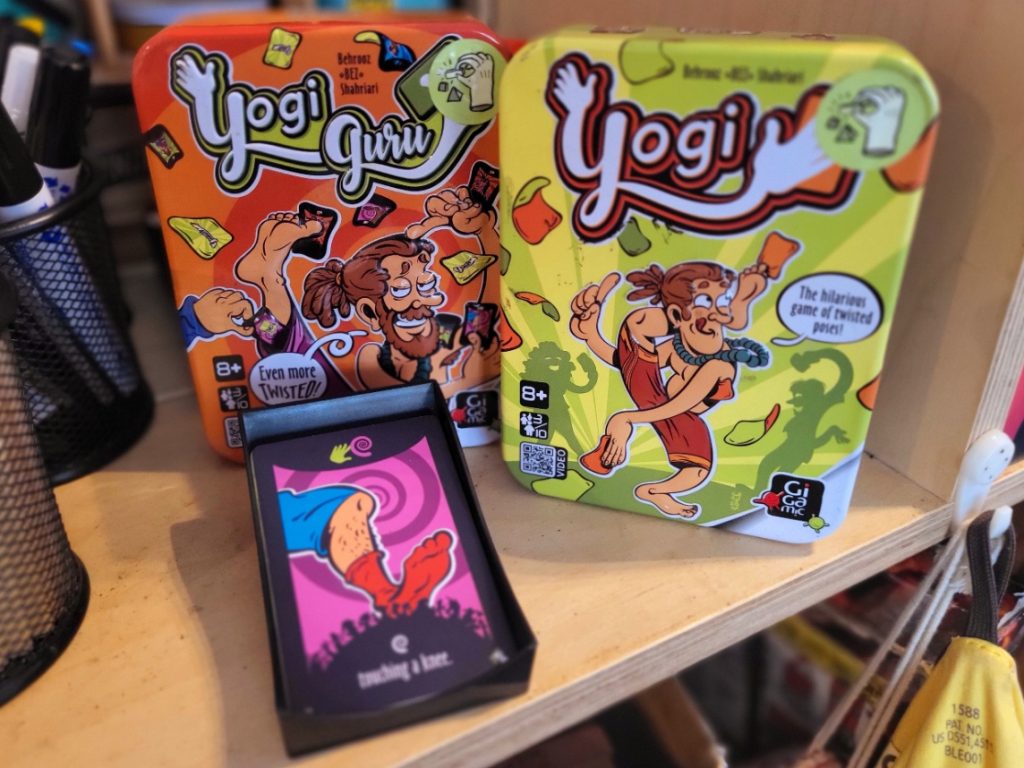
Playable in 10 to 15 minutes with up to 10 players and what you have here is potentially the perfect filler game. Start the evening with it, play it between games, play it at the end of an evening. It’s versatile, small and genius.