
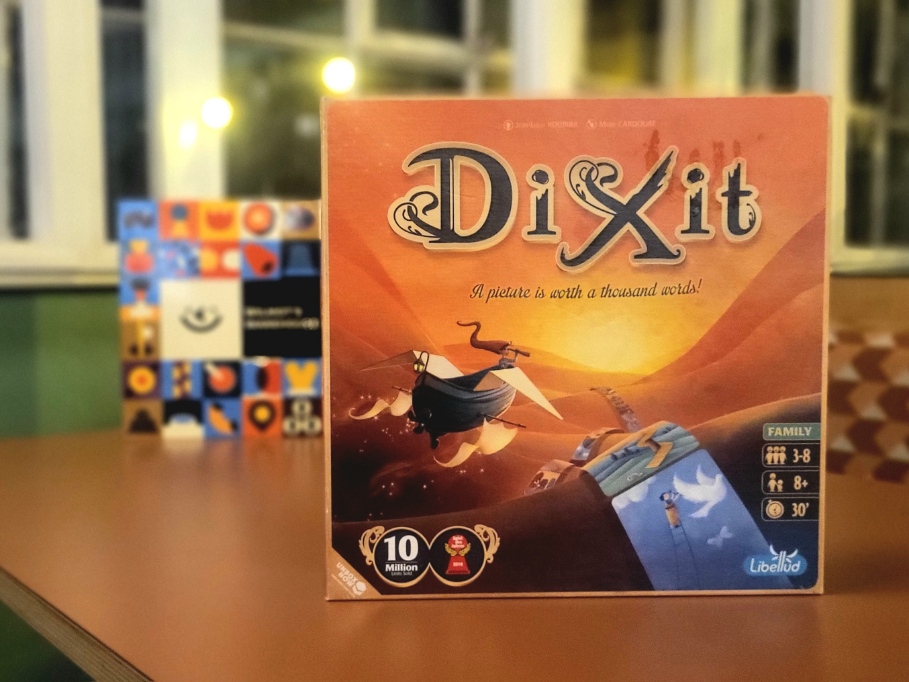
Humanity can be seen to be defined as seperate from the rest of the animal kingdom by one thing, the ability to tell stories, to describe the undescribable and to imagine. Enter Dixit.
Back in 2008, Dixit entered the board game scene and a few years later it won the coveted Spiel des Jahres award. We’ve mentioned THAT enough times that you should know what that it is by now, but what is Dixit?
At its heart Dixit asks players to tell stories about images but in a way that leaves it open to interpretation. The idea is simple, in essence, each round one person is the story-teller and will phrase a description of one of the beautiful cards in the game that they have in their hand and place it face down on the table. All other players choose a card from their hands that also follows this story and adds it to the pile. Cards are randomised and shown and players guess the original card and points are awarded. There are a few extra twists, such as, the story-teller only gets points if some, but not all, of the guessers get the right answer. So, you can’t be too specific, but also if you are too obtuse and nobody guesses, you’ll also get no points. Players also get points for their card being chosen over the original so getting the right choice of card is crucial.
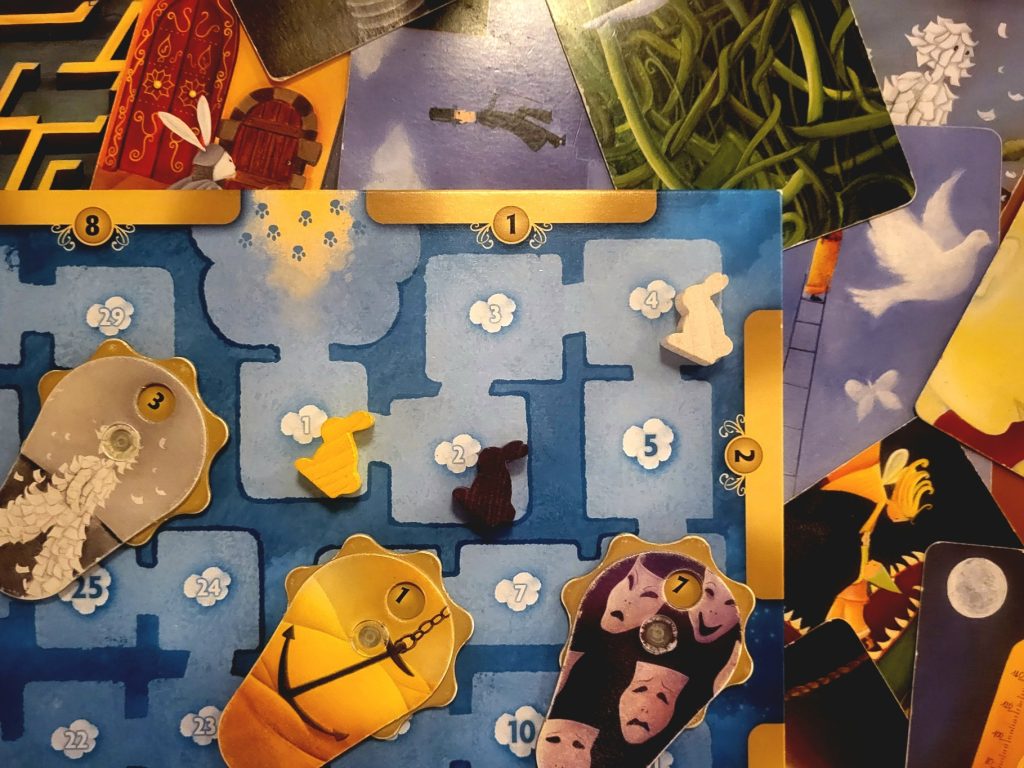
It’s a beautiful game and over the years 10 expansions of new cards have been produced including a set of cards that features the artwork from the National Museum of Krakow. There have also been a number of spin off games, Odyssey and more recently Stella springs to mind, that changes the rules up to varying degrees. Even the base game has changed over time in various improved ways and a Disney version has also been produced.
Imagination is always stimulated by a good clue in Dixit and that makes this a great game for all ages. Description skills are the keystone to the gameplay here and that’s where the new challenger comes in…
The new description based game contender: Wilmot’s Warehouse
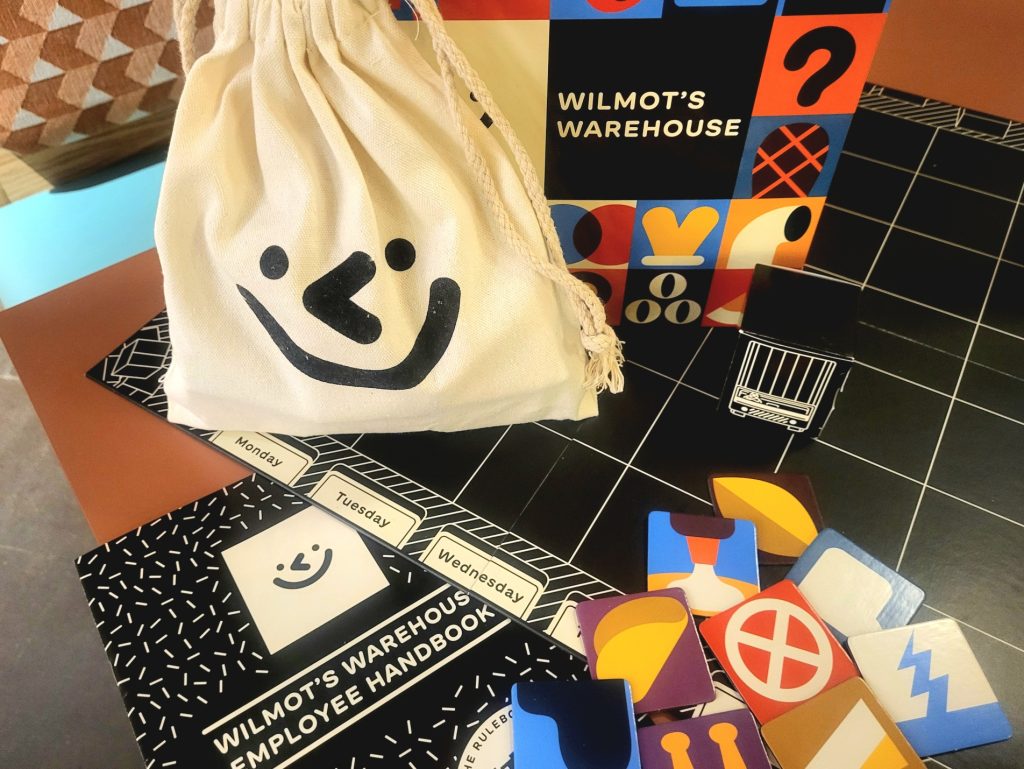
Well, look at that. Isn’t that a great looking game? The production quality here is excellent, from the beautiful canvas bag to the chunky tiles. There is a lovely bit of thematic tie-in too, from the box with the cards in it looking like a lorry to the ‘Employee Handbook’ rules. This is a beauty.
The game itself flips the script on Dixit’s description antics. In Wilmot’s Warehouse you are working together to memorise the layout of stock in the warehouse by telling stories. This is beautifully described by the stunning rules in a very easy to read casual way. It’s a master class in great rules.
But here’s the general idea… you’re all working for a warehouse company and new stock is coming into an empty building and you have to stack it up and remember where it is. Sounds simple? Well, you’ll only get to look at the stock when it comes in, once it’s placed you can’t see what’s in the boxes. So, to remember where stuff is, you’re going to have to tell each other little stories to recall the location of things.
Every day 7 new boxes of things arrive, Monday is fine… you are left to your own devices. Every other day there is a memo from the Head Office with a ‘Mandatory Idea’ that you must follow. These are lovely little curve balls, some easier than others. Have a couple of randomly chosen examples… One day the management instigates a mandatory ‘Watercooler break’, you must stop playing the game and have a short break to talk about your day. Next, they decide to take away coffee privileges… so everyone can only use 1 syllable words for the whole day. Devilish.
Once Friday is complete then the orders come flying in… you won’t be able to fulfill them all, but the items you have in the warehouse are all going to be somewhere in there. The problem is you are expected to locate the right items quickly and correctly as you are playing against the clock. Errors go against your time and ‘corporate’ will rate you on how well you perform as a team.
Interpretation and imagination here is everything, all the pictures are abstract and could be seen as a number of things, discussion is key and how your story grows will depend on your group… Here’s a little example on how it might go…
It’s Monday morning and the first delivery arrives… frogspawn? Alright… each to their own… next delivery, a magnifying glass… useful for looking at the frogspawn so we’ll put it above it… another box, this has dog bowls in it… that’ll be good for holding the frogspawn under the magnifying glass so we’ll put it below the original… Now come the lampshades, they’ll be good to make sure you can see properly so we’ll put them above the magnifying glass that we are using to look at the frogspawn that is in the dog bowls… Now we’ve had a bear delivered… he likes to hold things so we’ll let him hold the magnifying glass above the frogspawn in the dog bowl that is all under the lampshade… and so the story gets weirder and weirder…

Laughter will flow from the stories you come up with and you’ll be amazed at how well you’ll collectively do at remembering where things are. After all, we are defined by the stories we tell each other and the narratives we weave lodge strongly in our minds. Playing this with kids is a beautiful thing to see, the mind-palaces that they build are wondrous to behold.
We’ve deliberately only described Wilmot’s Warehouse thematically, rest assured it’s delivered beautifully. Never have we played such an amazing memory based game before, believe us when we say, you have to try this. It’s humanity in its purest form, cooperating to build a strong, memorable narrative. We’ve got this at select sites and we love it, give it a whirl… and congratulations on your new job!