
So… we’ve recently done blogs on who goes first and also win conditions… What happens when those win conditions let you down?
You know how it goes, you’ve added up your score and it’s exactly the same as another player. What now? Who comes out on top?
Yeah, it’s tie-breaking time!
The Simple…
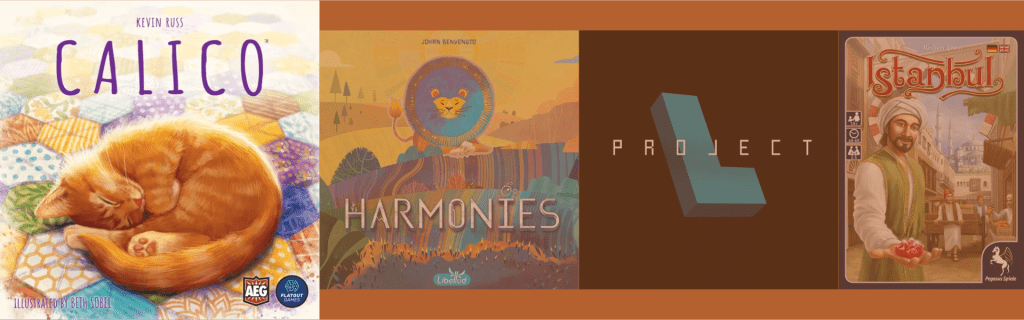
Let’s start with tie-breaks that are just further comparisons, potentially the most obvious of the board game world. For instance, Calico is a game about quilt making and the cats that settle on your quilt… you would normally add up all your points (from your buttons, collected cats and design goals) and see who is ahead. In a tie situation here you see who has collected the most cats, if it’s still a tie then you move on to see who has the most buttons on their quilt. Calico runs out of steam (or maybe it should be thread?) at this point and if it’s still a tie at that point then it’s a shared victory. So it’s a case of fluffy things before shiny things, nice.
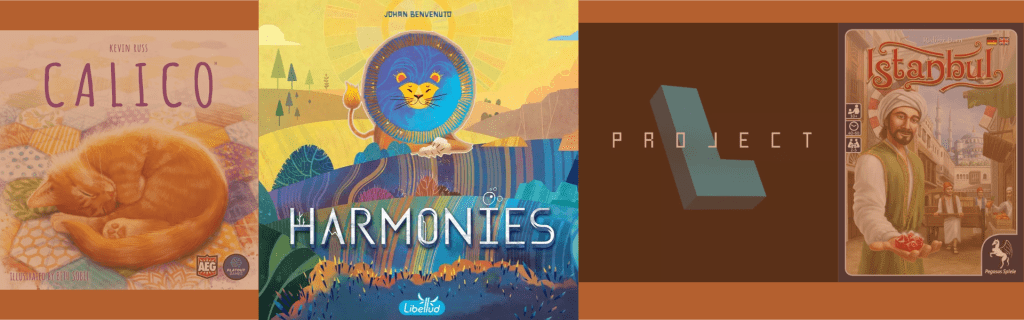
Harmonies is another simple one… in this game you are building beautiful landscapes in such a way as to attract animals to live on your land. If you tie for points here then the only tie-breaker is to count how many animals inhabit your landscape as the one with the most is now declared the winner, another draw and it’s a shared victory.
Here’s another simple yet sensible one, Project L. In this game you fill puzzles with your polyominoes and gain more polyominoes and/or points for doing so, it’s all about efficiency. It’s a very fair system as everybody will have exactly the same number of turns each and then a score comparison is made. The first tie-break is the number of puzzles completed, then it’s the number of polyominoes everyone has, after that, well, as it says in the book ‘If there is still a tie, all tied players share the victory. You are all awesome!’. We know you all are but it’s nice that a game recognises how awesome you all are!
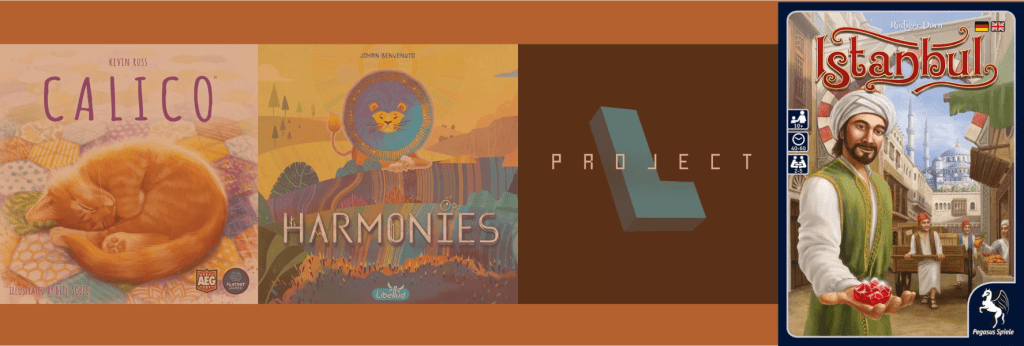
The heavier Euro-games are the ones likely to have a longer series of tie-breaks, take Istanbul for instance. In this 2014 classic it’s all about becoming a successful merchant in the bazaar district of Istanbul by filling your wheelbarrows full of supplies, transporting them accordingly and getting your hands on rubies (basically). First to a number of rubies will make the game finish at the end of the round so everyone gets the same number of turns. Clearly it’s the rubies that matter most, the first tie-break is for leftover Lira, the second is spare goods on your wheelbarrow and the third? It’s leftover bonus cards and only after that does it become a multiple winner situation.
Right… enough of the boring stuff, let’s check out something a bit more out there.
The Zany…
Right, you want plain weird? We can do that. You’ve met us, haven’t you?
In Plague Inc. you’re a disease looking to be the most efficient at taking out humanity. You’re evolving, spreading, taking out whole countries, just doing what any good killer diseases would do. Once the world is in tatters around you it’s a totaling up of points situation as in most great games, but what if it’s a tie-break? Well there is one way to determine the winner. The first to lie on the floor and pretend to be dead wins. Whaaaa…?
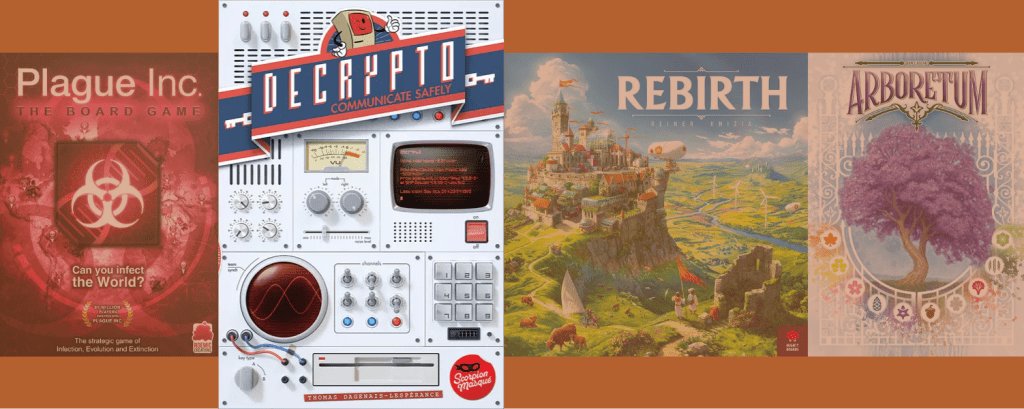
Now… that’s a bit crazy, how about one that is more fun than mad? Decrypto is a great code-breaking game for two teams… Each team has a set of four words numbered 1 to 4 and by giving clues they want their team to guess a three digit code using these numbers without the other team intercepting their code. Sounds dull but it’s oh so good!
Get two interceptions of your opponent’s code and you’ll win at the end of the round BUT fail to get your team to guess the correct code twice and you’ll lose the game at the end of the round. With only 8 rounds to win in it’s a nail biting tightrope walk of a game being obscure enough in your clues so that the opponents fail but not so obscure that your team mates do… The only issue here is one team can lose and win at the same time or the teams can both lose or both win in the same round, if the number of Interceptions and Miscommunications are equal at this stage then the two teams make guesses at what the words of the other team were and the one that gets the most is declared victorious. Now that’s a fun way to solve a tie break!
Let’s go for a bit of an odd one here next, we’re going to go back to one of our favourite recent games, Rebirth. This is less weird but is rather intriguing. In Rebirth the clans are looking to rebuild Scotland (in the base game) after a series of environmental calamities. Once final scores are tallied then there is the first tie-break check and that’s to see if any of the tied players have control of Edinburgh Castle. If they don’t then here’s the kicker, the player who controls Stirling Castle wins the game even if they did not have enough points to win the game! Not many games are brave enough to pull a stunt like that! Manage to get Stirling Castle early enough and you could win the game even if you don’t actually do very well. Barmy.
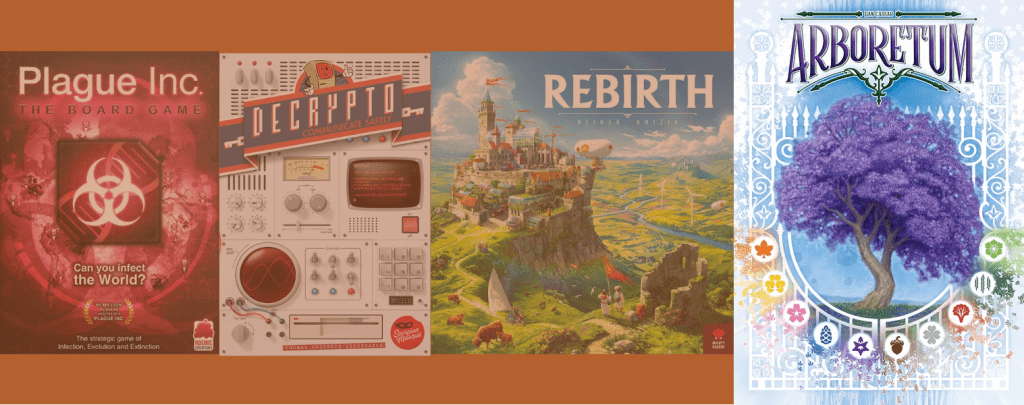
One last game we’re going to mention and it’s a doozy. Arboretum looks like a beautiful and chilled game of planting trees, be warned! It’s highly competitive as each tree can only be scored by the player who has the most of that tree in their hand at the end of the game. There’s more to it, but it’s cut throat and aggressive, trust us. The tie break is pure genius though. If after all the nasty goings on have happened then if it’s still a tie then those tied must plant a tree each. After five years have passed then the player who has planted the tree that has grown the tallest has won the game!
We’re always up for more trees being planted, that’s for sure.
___
So, whenever you play a game, don’t forget to check the rules for a tie break halfway through the game. The worst thing that can happen is to tie and some arbitrary rule gives the game away to another player, it’s always better to plan ahead!