
There’s been a bit of a trend recently that when a game becomes popular it is adapted to become a 2-player only game. Some are greater than the original, others fall by the wayside. We’re coining the term ‘Duofication’ for this practice and this is our first blog looking at one of these specifically. So where do we start? Well the recently released Azul Duel seems like a great idea.
Where it came from…
In 2017 Azul burst onto the scene and made quite a splash. The designer, Michael Kiesling, had come up with a game with innovative gameplay and since that time it has now become a very popular abstract tile placement game. So much so that it is now seen as one of the modern classics and we agree with that as we see it played in all our cafes daily.
So, what is Azul and why is it so good? Well, you should first know that it plays beautifully from 2 to 4 players (so much so we mentioned it in our first specific four player blog) and is a tactile treat whichever version you go for. They honestly didn’t need to make it a 2-player only game as the original is great at that player count (although SPOILERS: we are glad they have).
The basics of the game are collecting tiles from a central display to fill your own personal board. You each have a twenty five space board set up in a five by five grid. There are five patterns of tile to gather and each row and column has a space for each type of tile without duplications. Spaces can only be filled at the end of a round and to fill a space you’ll need a certain number of tiles of the same pattern in the correct rows storage area. The top row needs a single tile, the second needs two, the third needs three, etc.
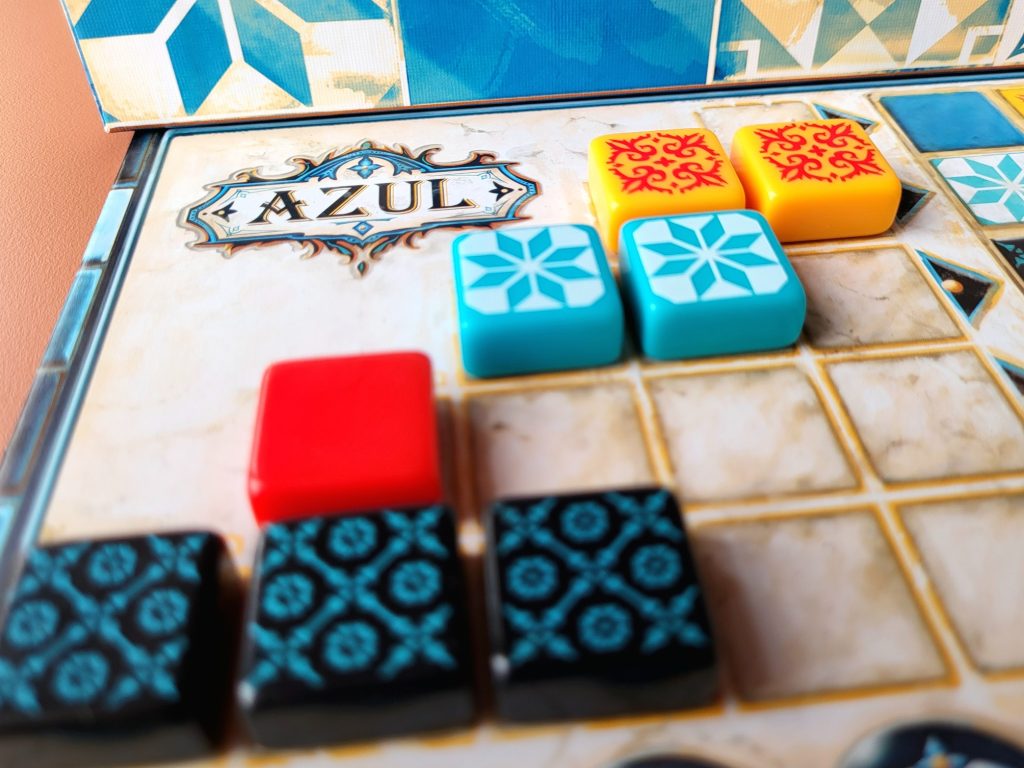
So, how do the tiles get from the central display to your personal board? Well on your go you choose an area with tiles on the central display (a ‘factory’ at the start of the round is your only choice) and take ALL of the tiles of one pattern and decide which row’s storage area you will place them all in. At the start of the game you can put what you want where you like but on subsequent rounds, if that row already has the space with that pattern filled in, you can’t put it there. Also, if there are too many to go on that row then any extra will lose you points.
Here’s the fun part, any tiles left over in the ‘factory’ that you took from are moved to the middle of the central display and form a new area you can take tiles from and this grows over the round. First to take from there gets a penalty but also goes first next round. So you can see what your opponents need and potentially mess up their chances on your go leading to some annoyingly inefficient turns for people… Much fun!
Once all the tiles are taken then stored tiles are moved from storage to your spaces (as long as you have enough tiles on the row) and points are scored for clustering tiles together on your board. Play until a round in which a row is full and then score some end game bonus points. Most points wins! Easy… there is a bit more to it but it’s not hard to get your head around once you’ve played a round or two and you’ll likely want to have another game right after to hone your skills. As it is we’re not here to talk about Azul… it’s the new two player game we’re interested in but a basic understanding of the game is useful before discussing the Duofied version. If you’ve not played the original, we recommend you should try it, it’s honestly a wonderful game.
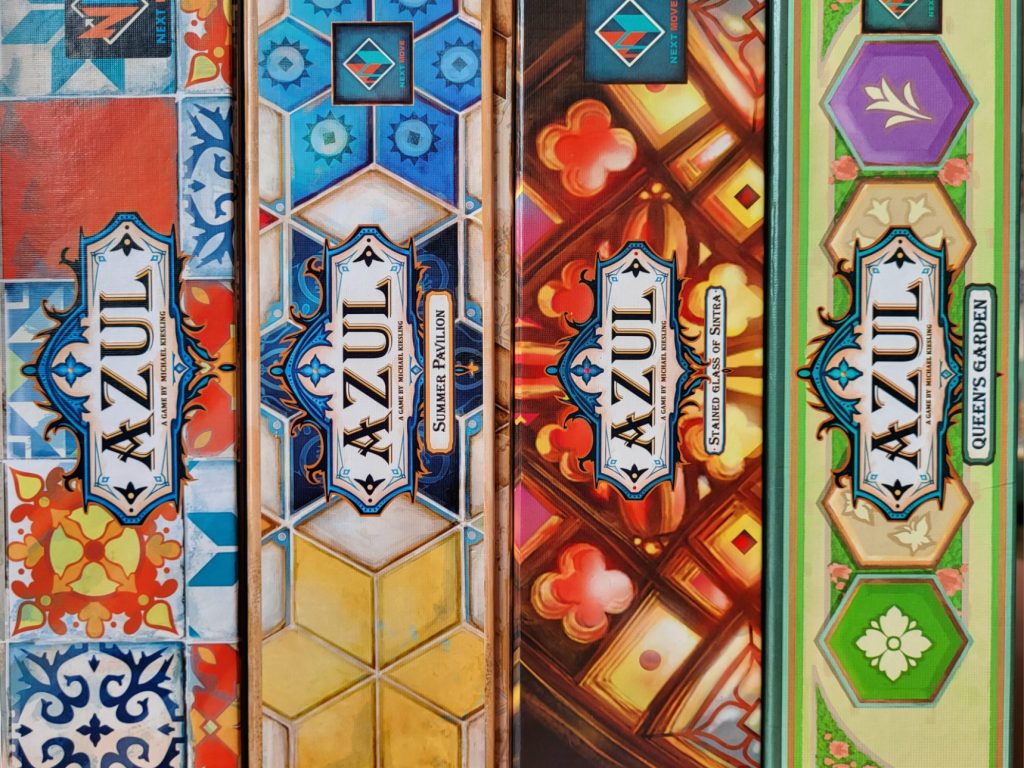
There are three other (four if you count Master Chocolatier which just has a slight twist on the original) versions of the game and they all bring variations to the rules (except Queens Garden which is a different beast altogether), we particularly like the Summer Pavilion version but everyone has their favourite.
3, 2, 1, Duofication!
So, what does Azul Duel bring to the table? We’ll start by saying we think it’s one of the closest to the original when compared to the other games BUT there are enough changes to increase the difficulty somewhat. The fact it’s just for 2-players is probably a good thing, it would be really difficult to anticipate the state of the game on your next go with any more players.
To make it a ‘duel’ you would think that interactions between players are going to be increased and this is definitely true. One of the first things we noticed is that there are now other actions you can take on your go, this lets the players control the pace of the game a bit more than the original. As mentioned above in the OG you will always take tiles on your go so the state of the central board will always change between turns, not so here as there are two other options.

The first of these is to gather a Dome-plate from the main board. In the OG what pattern tiles go where is predetermined by the layout of the board, here you need to place a Dome-plate that covers a two by two area of the bigger six by six personal grid and that dictates what tiles can go there. Every round you have to take this action twice but with only three dome plates to pick from, one of you will have to draw blind from the stack. This will cost you points too, spend more points though and you can draw extra and choose…
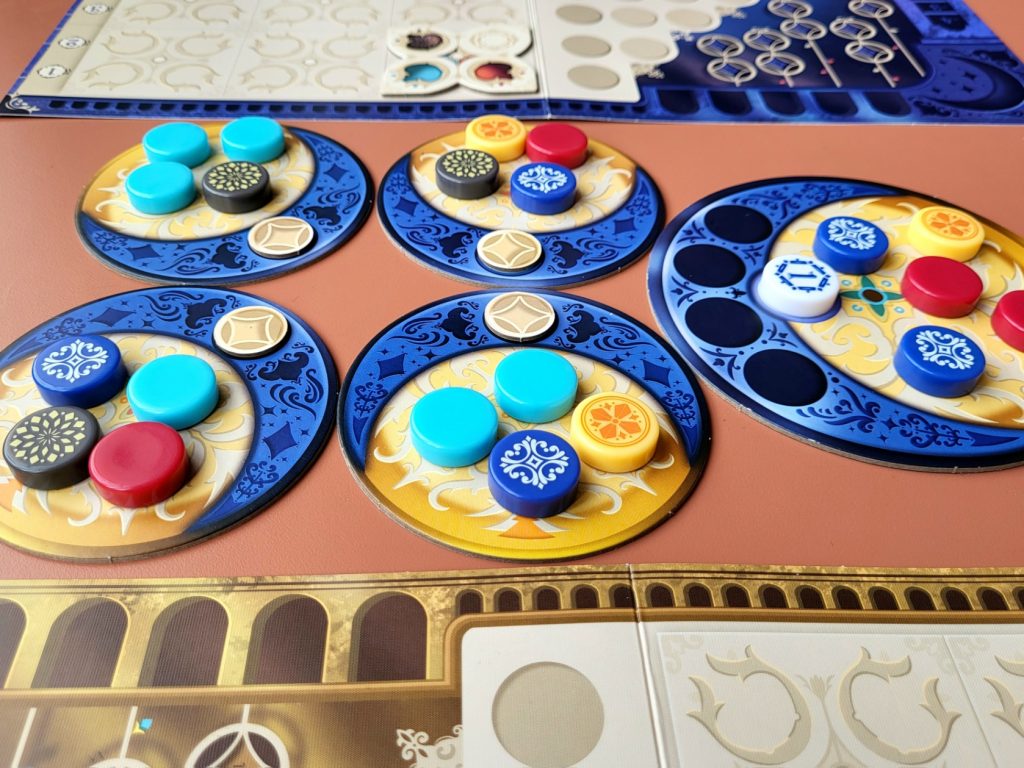
The way the tiles move when you pick them has changed too… They all start in the ‘sun’ part of the factories and will move to the ‘moon’ part on taking a matching set from them. The smaller factories now have their tiles stacked (takers choice on order) whilst the large factory has the first player token on it and all tiles are kept spread out. Now when choosing to take from the moon (what was previously the middle of the central display) you can only take the top most matching tiles. This leads to some great interactions. Once all tiles are gone from a ‘moon’ then a bonus tile is revealed and now the second of the new actions become available, taking a bonus tile. This action can only be taken twice by each player and again can change the pace of the game leading to some very clever plays.
Other changes include using those bonus tiles to replace missing tiles from your board when filling spaces on your board. There are also two newspaces, a ‘Joker’ that can take any colour tile and another that is named ‘Special’ and is only filled in when the other three spaces on its dome plate are filled in.
Here’s the last of the changes we’re going to mention, the end game scores are variable, they are picked at the start of the game and can be totally different to the original. You’ll need to bear in mind that there are only five rounds to the game and now as it is a six by six grid, if you need to complete a row for bonus points then you will have to get one of those ‘Special’ tile spaces as it is the only way to fill in more than five spaces in a row.
Final thoughts?
We don’t feel like we’ve truly done this justice in the limited space of this blog but it’s a great overview. For those of you who love Azul and play two-player a lot we heartily recommend giving this one a go before purchasing it to see if you like the extra levels this brings to the game. In our opinion it raises the complexity factor but adds some great decision spaces to an already excellent game. Maybe pop by one of our cafes and have a game with your ‘player two’ to see if it does it for you?
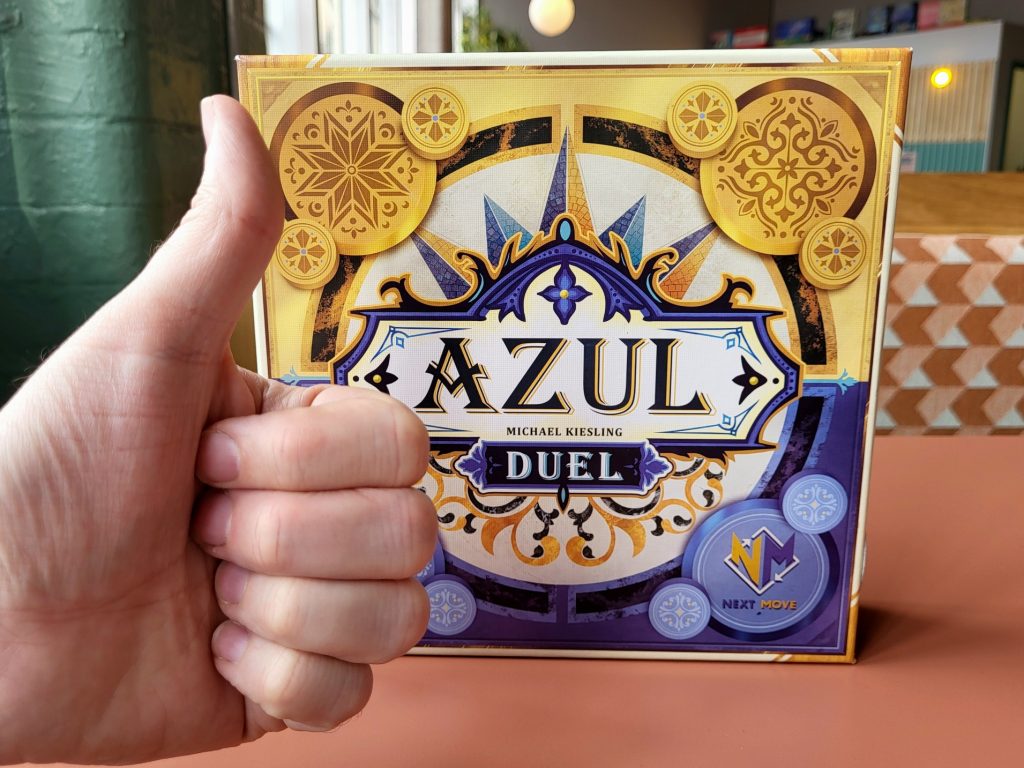
Azul Duel is definitely a thumbs up from us though, we think you’re gonna love it.