

Another new series? What are we doing to you? Well this one is a little bit different to what we have done before!
As you probably know, we love great games… but can we make them better?… with a little C&C houserule or two, maybe we can!
Not all games are made better with houserules (we’re looking at you Monopoly and Uno) but as we make a living out of showing off groovy games, we’ve come across a few ‘tweaks’ in the process… So, here is our first ‘GameHackz’.
—
Back in the early days of this blog we mentioned how amazing Hues & Cues is as one of the quintessential party games when you have a large number of players.
Here’s a reminder of how great it is and along the way we’re going to throw in a couple of GameHackz to (hopefully) make it even better!
A good time with a rhyme.
Alliteration and rhyme, raises the bar (by far) for the name game. Hues and Cues is a great example of the latter patter.
But, despite my efforts to get that rhyming down (don’t frown), it’s actually all about colour and clues. Now THAT sounds like a boring game.
The first thing you’ll notice is the ridiculously colourful board. There are exactly 480 squares here, each with a slightly different colour in. This is very much the center piece of the game.
After that you’ll see a stack of 100 cards, each with 4 colours on. That’s only 400 colours… ooo… interesting, we’ll come back to this later ([HACK-4]).
Then there are 30 tokens in 10 colours, that’s enough for 10 players to play with.
[HACK-1] :- Got more players? All you need are 3 matching game pieces from your favourite game and you can easily play with more people! Or just use odd game pieces anyway to make it more personal!
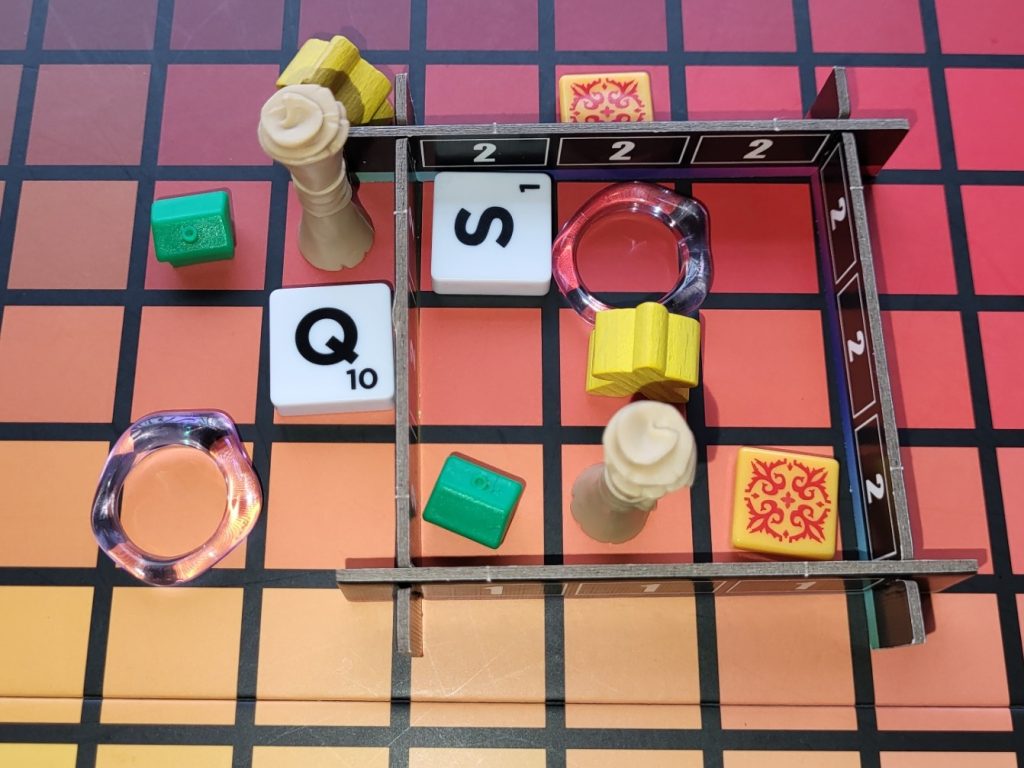
So, how do you play this gem? Well, everyone will get a chance to be the Cue-giver, they have one of the cards and will give two cues to the rest of the group. The Guessers will use their tokens to guess what colour they are giving out cues too.
[HACK-2] :- Don’t use what you see on the card to give out your cues. Sounds odd when you put it like that but, bear with us. The Guessers will be looking at the board and on the board each square is surrounded with other colours that are not on the card. Those other colours influence how you see the square you are giving your cue out to. It’s so much better to give the cue out to what the Guessers are seeing than to what you see on the card. (also the card is a different material to the board so the colour matching under certain conditions isn’t always perfect!)
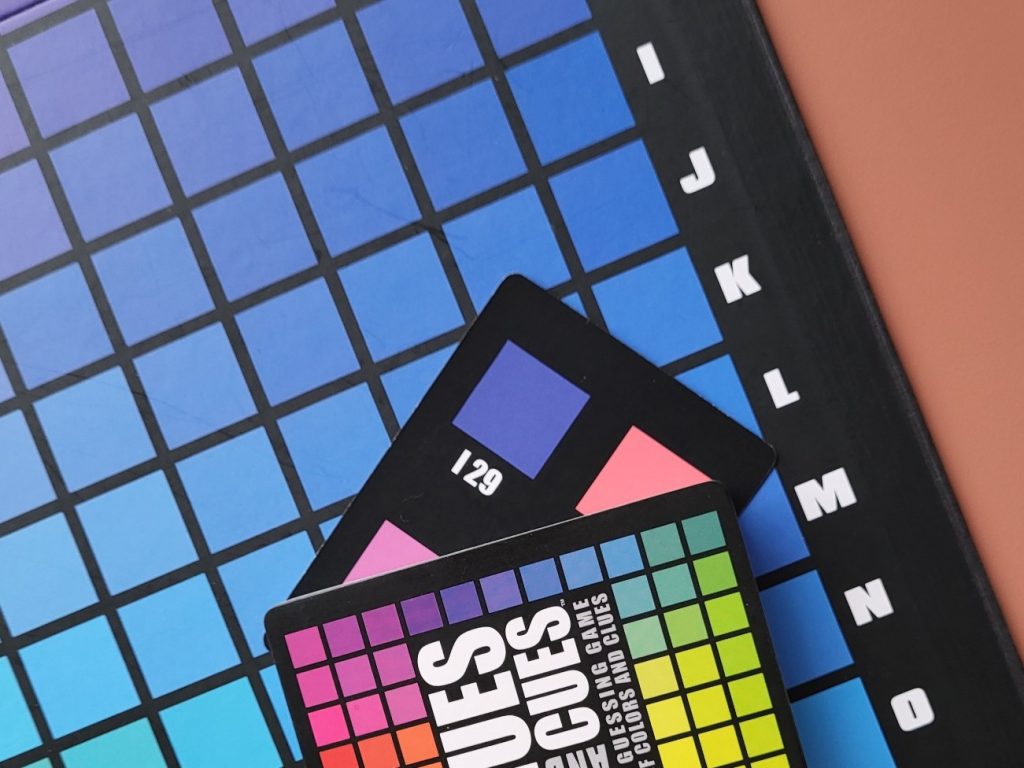
In the first round for each Cue-giver they can only use a single word and it can’t be a basic colour, there are another few rules to abide by but we’ll leave you to check those out. We’re all about the hacks and here’s our favourite…
[HACK-3] :- When you are staring at your card and the board and everyone else is looking at you, your mind goes blank and you can’t even think of the word green, let alone figure out what would be a great descriptor for that specific shade. So, as each player should be the Cue-giver at least once, why not give everyone a card at the start of the game and they can plan ahead what cues they are going to give without any awkward stares or silences.

Every Guesser in clockwise order places their first token out on an unoccupied square as their ‘best guess’. The Cue-giver then gives a two word clue for the same colour and then in anti-clockwise player turn order the second tokens are placed out.
You don’t have to have a second round if you don’t want to as the Cue-giver and you can just use a single word in your second round if you so choose.
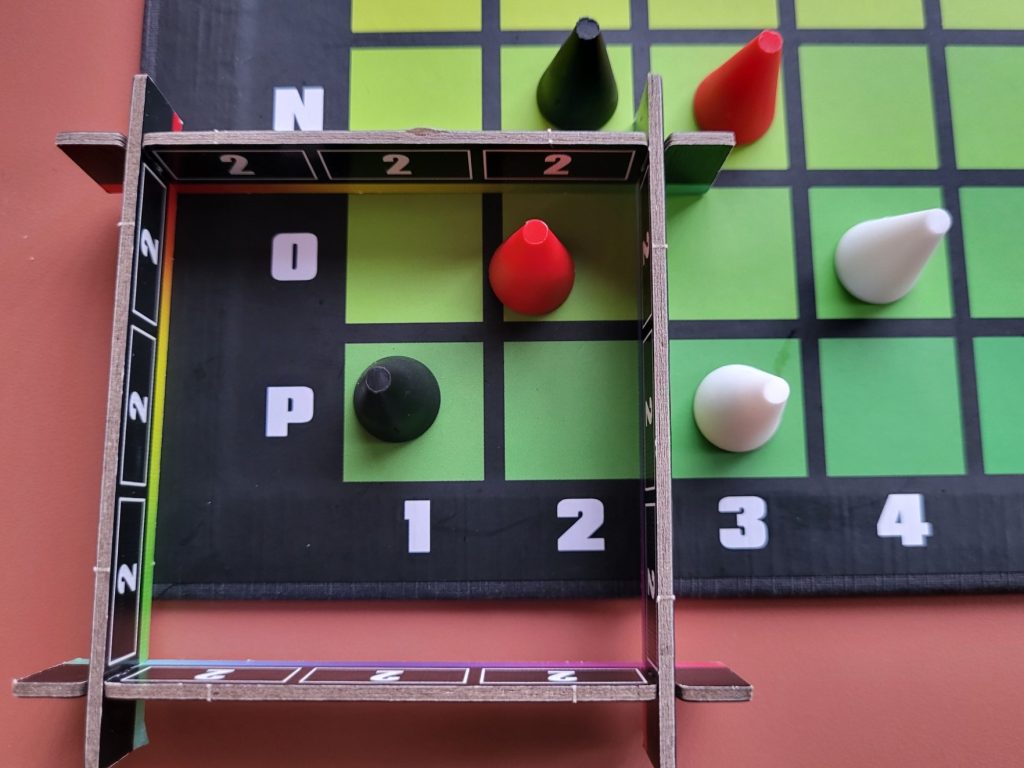
When all Guessers have placed two tokens, then the scoring frame is placed centred on the location that the Cue-giver gave Cues out for and you score. Guessers get 3 points for a perfect answer, 2 for any of the other squares in the frame and 1 if it is right outside the frame. Cue-givers get a point for each token of any players in the frame.
[HACK-4] :- Isn’t really a hack, just something worth knowing… None of the cards have any of the colours from the outside edge on them. Probably, as it would be rubbish scoring in that round. Also as the Cue-giver why would you choose an edge or corner colour that would minimise your score to 6 or 4? When you point it out it makes perfect sense and now you know, you know.
So, that’s the game. The fun comes from the choices all players make, be they good or bad and the conversations afterwards. Language and colour are clearly linked to different parts of the human brain and everyone does these things slightly differently, there in lies the puzzle.
For example, what colour is salmon? Scales? Wild? Farmed? Cooked? Or Ross from Friends?
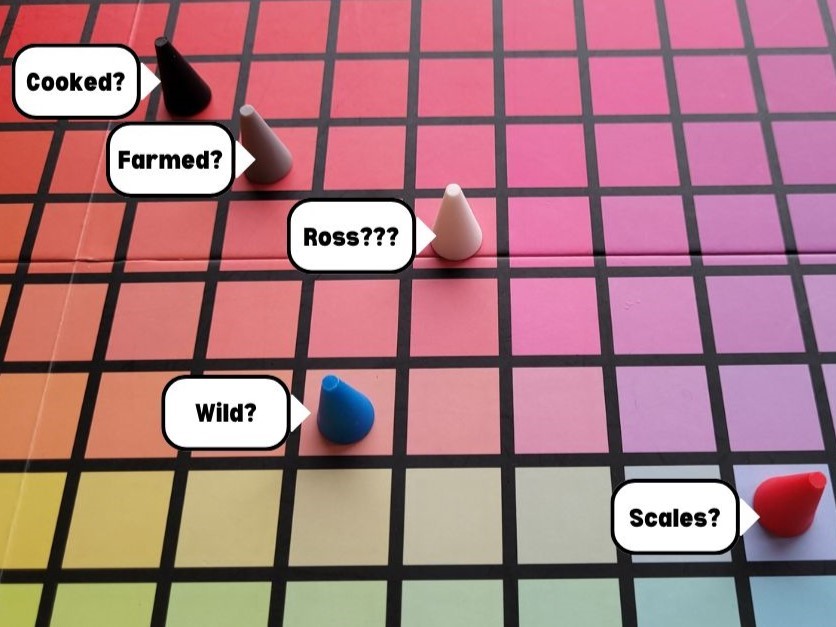
Now you get it and hopefully our Hackz have made it a bit more awesome.
You’re welcome!