Learn all about one of Chance & Counters’ most exciting events from our storyteller, Iestyn!
On the stroke of midnight, a scream thunders through a quiet town. Following the sound, townsfolk find their beloved storyteller has been murdered; his body left hanging upon the clock tower, blood running down its face.
Welcome to the sleepy town of Ravenswood Bluff, where hellish forces have been unleashed and good must strive to stop evil before it is too late…

Putting a fresh spin on classic deception games like Werewolf and Mafia, Blood on the Clocktower (Blood for short) has become a spotlight event at Chance & Counters. It’s a bigger, better version of those games we loved as children: more immersive, more complex, and more fun.
Since the new year, we’ve expanded the variety of Blood sessions we run, from beginner to legendary. So, if you’re curious about the game and want to learn some basics, to figure out which session to attend, and to have a reason to leave the house without regretting it, have a read! Hear from our head storyteller at Cardiff C&C about the game and how we run it.
If you ask me, an evening of murder, mystery, bluffs, and lies sounds pretty good!
Meet your Storyteller
(Miriam): Do you want to tell The People™ a bit about yourself, your work at C&C?
(Iestyn): Yeah, I’ve been working here, in Cardiff, for 4 years, working Front of House, and do everything to do with all the games, have all of the fun to do with all of the games.
M: You’re currently our Head Guru at Cardiff C&C. But how long have you been running Blood?
I: Three and a half years, give or take, with two games every two weeks. Lots of storytelling.
M: Did you used to play the game before starting?
I: I played one game before starting storytelling!
M: Learning on the job! Good stuff. Do you want to explain who the storyteller is?
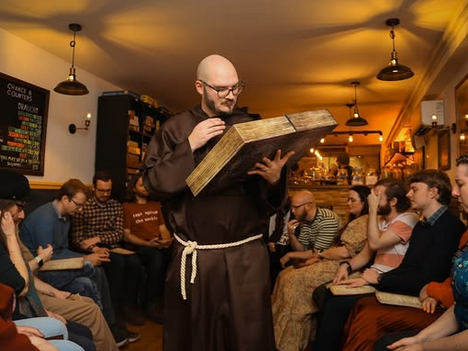
I: The storyteller is the person that guides people through the game. They run the session, pick scripts and characters, give out information as required, and also help in rule clarification. They make the story happen: storyteller.
What is Blood on the Clocktower?
M: Would you like to give an intro to Blood, how it works?
I: Blood is a social deduction, murder-ish mystery, work-out-who-in-the-room-is-the-bad-guy-and-kick-them-out, where each person has a different role that gives them different abilities, from protecting other people in the room, to gathering information, spreading false information, or good old murdering!
What are Scripts?
M: And each game follows a script, could you explain what a script is?
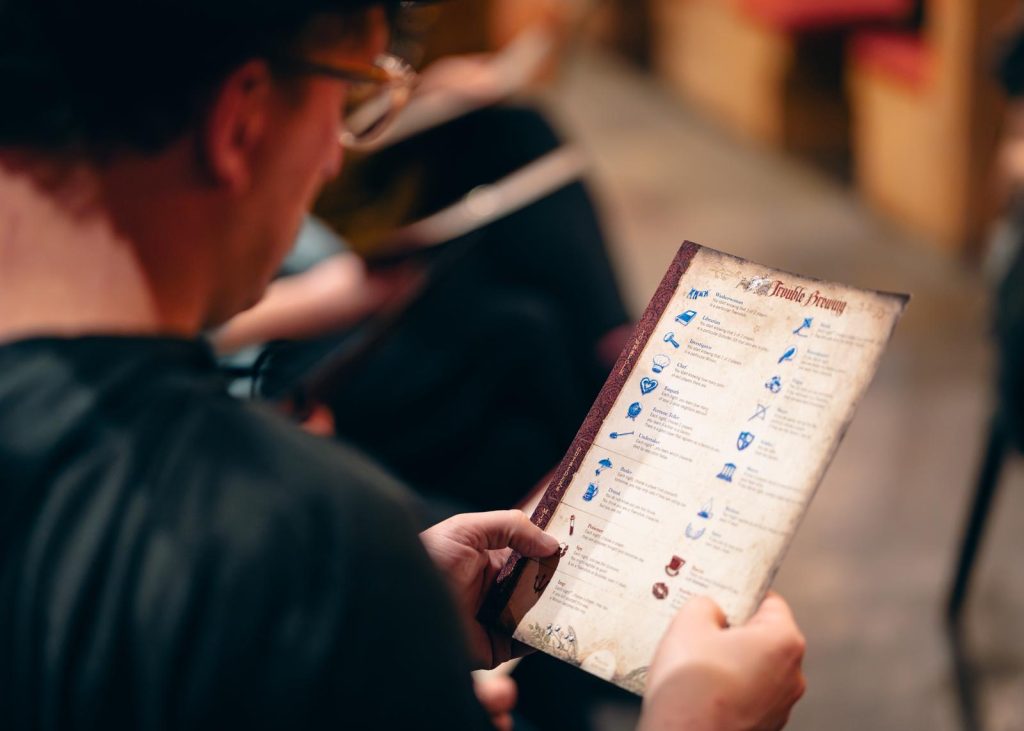
I: Yeah, so a script is a list of about a maximum of 24-ish potential characters, plus their unique ability, that could potentially be in the room. Characters are split into two teams: good and evil. Good wants to figure out who is evil (and kick it out), and evil wants to eliminate good.
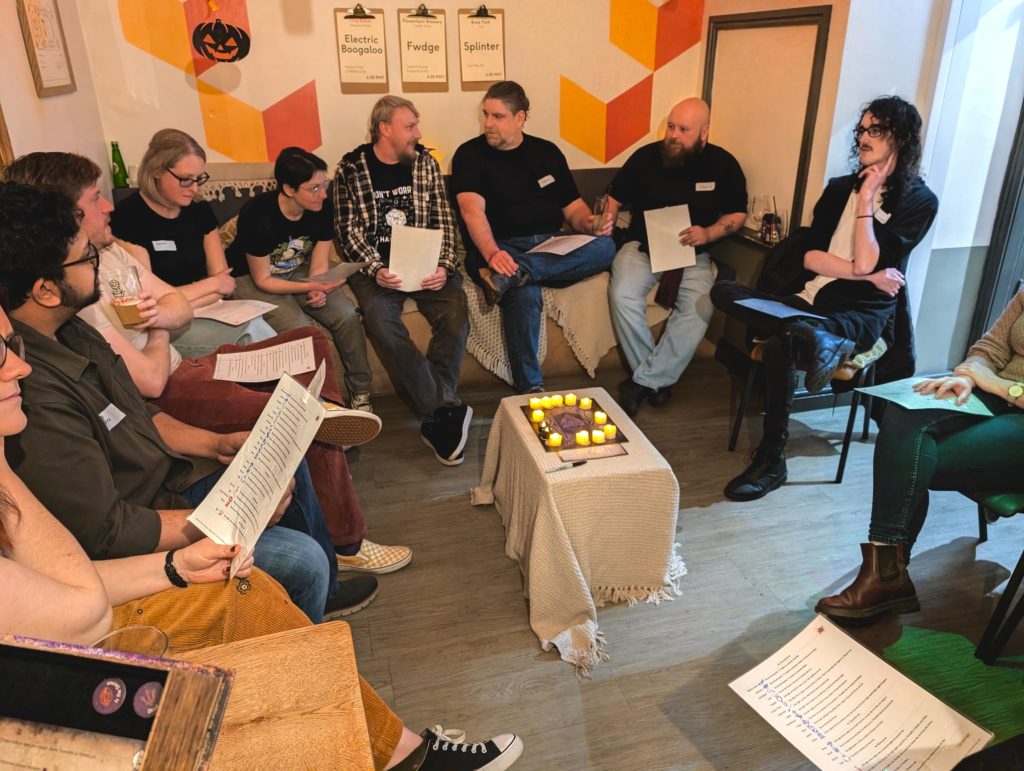
Our games at C&C usually host between 10 to 15 people. At the start of each game, the storyteller picks out a number of characters from the list of potential roles, and these roles are then randomly assigned to players.
Only you and the storyteller know who you are, and rarely will you want to be upfront about your identity if you want to win the game.
Those spare roles, that are in the scripts but weren’t assigned to anyone in the room, allow for some lying, some bluffs to be easily useable.
How Does the Game Work?
M: So, once you have your characters, how does the game go?
I: The game is split into two stages: night and day. During night, characters get to secretly use their special abilities, getting information from the storyteller, choosing who to protect, kill, or investigate.
Then, during daytime (after finding out who died over night), you get to chat with people, try to deduce who might be who, make some allies, plan some strategy. And at the end of the day you get to accuse people you think might be evil, and if you get enough votes, execute them!
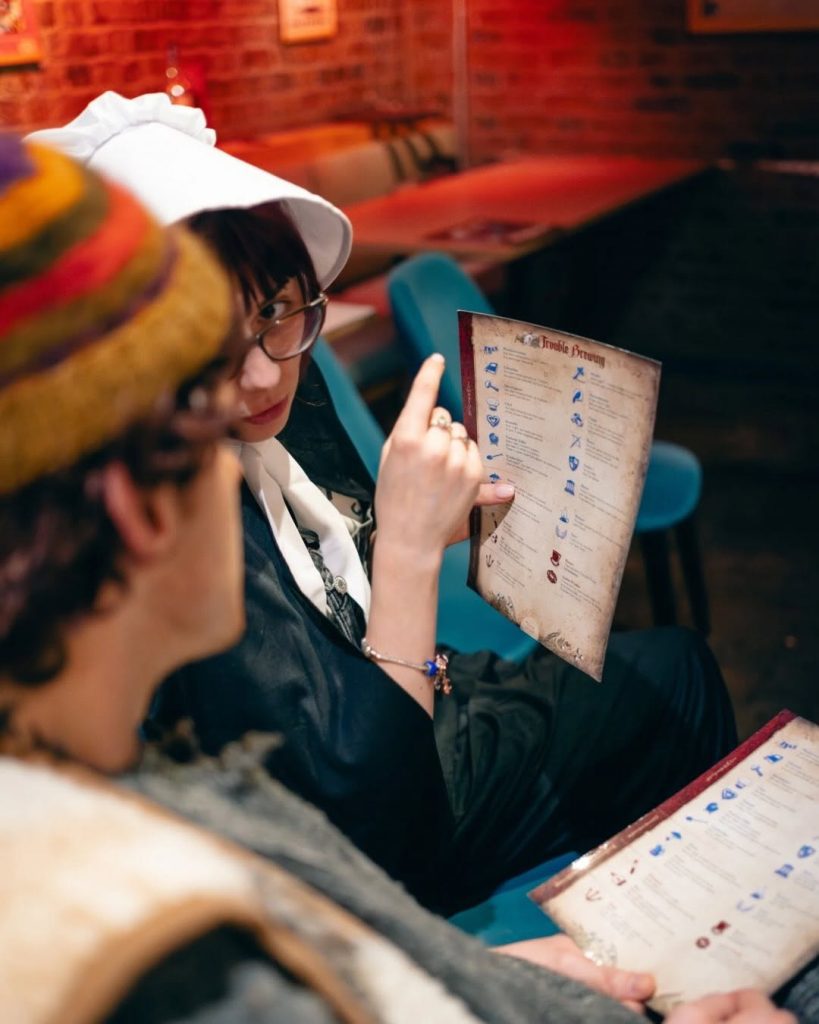
These two stages repeat until one of the teams wins by eliminating the other.
One of the unique things about Blood is that the dead still have some power. For example, during the daytime trials, while living characters can vote an unlimited number of times, the dead have one last vote, so they have to choose carefully when to cast it.
This means that the social part of the game, the talking to people, scheming, testing theories, never really stops, even if you are the first kill.
Why Play in Person?
M: So, you can play Blood online, but what would you say is the advantage of playing in person?
I: In person, you get a bit more of the social reads, so if anyone has a lying tell, you can very easily see it. It has more of a sense of community, because a lot more people will talk in between rounds, or overnight.
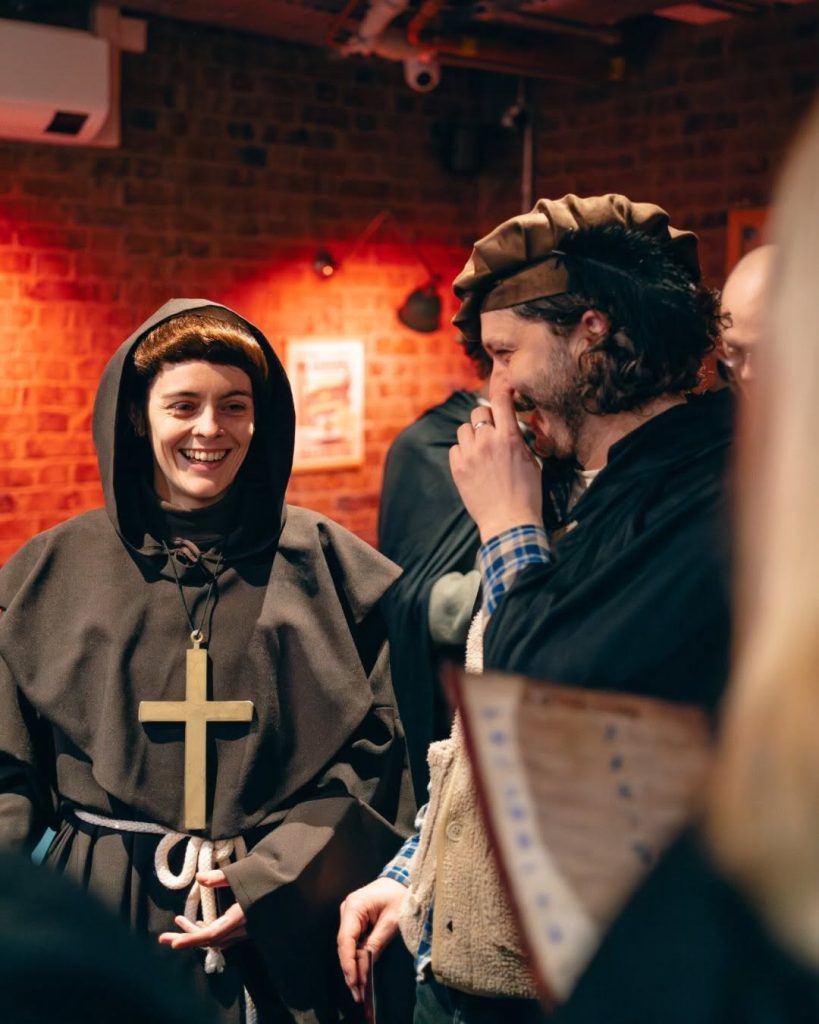
Online, the nighttime is nigh-on instantaneous. You get the information, and two seconds later it’s over. So people can be a bit more chatty, in person, have more of a relationship, (even annoy the storyteller, and inadvertently trip him up because their eyes are shut and they can’t see he is about to step on their foot at night).
M: I always like the nonsense chatter that pops up during the night. It’s a lot about the music playing in the background.
What I’ve heard people say, during sessions, is that, even though you can learn game mechanics and some strategies from playing online, the atmosphere is less friendly. It gets much more competitive and tense, which is not what some people want, especially if they are learning.
It’s also more atmospheric, in person. I always get concerned that first time customers coming to Chance will go upstairs to use the bathroom, look at the room where Blood is going on and think there’s some sort of weird board game cult in there. Sometimes they look a little concerned about it.
Picking your Session
M: So at Chance & Counters, we’ve started offering several different types of Blood sessions.
I: Yes, not every location offers the same event-type. Leeds, Birmingham and Gloucester Road have beginner-friendly, mixed games. Cardiff has different levels of difficulty, mostly because I’ve been dabbling in the larger arts of script making. I went head-long in and said yeah! ‘bounce! Let’s go!’
M: Could you give an overview of the different sessions we offer, who are they best suited for.
I: Yeah, so currently we have four different sessions in Cardiff.
Beginner Friendly is… beginner friendly. It’s gonna teach you how to play the game, beginning to end. You can still come along if you’re not a beginner, because it’s still a fun game.
M: And for beginner you use the ‘Trouble Brewing’ script, yeah?
I: Yup.
Then our Advanced/Intermediate sessions (name is still in the air), that one gives people a bit of a more fleshed out game experience, but you are still doing the other two scripts that come in the box, (‘Sects & Violets’ or ‘Bad Moon Rising’). It gives people just that little bit more challenge, and not just always playing the same script over and over and over again.
Next, we have our Custom Nights, where storytellers go absolutely insane and make whatever script they want to do. Sometimes, they don’t even know exactly how it’s all going to work out.
M: Is ‘they’ you?
I: Shh…
Finally, we have, just starting out, our new Legacy script format. You buy one ticket and come along for 3 nights of games where every time someone is executed off the script that character is eliminated from the script and replaced with a new character! So the script is ever evolving. And ever more complicated.
Script-Making
M: You’ve started writing your own scripts. Could you share a little about that? What is your process?
I: So, I do some of my own scripts. Typically, I’ll find 4 or 5 characters whose interactions I quite like. I throw them onto a script, make them focus points, and go ‘right! How do I make the rest of the script work around these characters?’
Then, I try to add characters to the script that enhance that central interaction, that flesh out the script without taking away anything from core bit I want to do, (like the entire town being drunk all the time.)
If in doubt, everyone can be drunk! It was chaos. It was just too much drunk.
M: Which characters do you gravitate towards when making a script?
I: Personally, with it being in person, and the fact that, especially in the more advanced nights, a lot of people know each other from previous sessions, I gravitate more towards the ‘social deductiony’ characters, roles that get people interacting with people because they are quite fun.
Otherwise, I quite enjoy ‘drunkening’/poisoning characters, because it adds chaos! It allows me to lie to people, which is fun! 🙂 When you’re getting to lie, it also makes my job as storyteller more fun than just sitting there and telling everyone the truth.
M: The storyteller is also a bit of participant, yes?
I: Yes, a soft participant, in the sense that, during the game, if someone is confused, or someone is lost, or someone’s forgotten the information you’ve told them last night (even if sometimes the storyteller has forgotten the information he told you last night), I’m there to help.
You go round, you give information, but you are also part of the game. So if you have the opportunity to lie, you lie!
Of course, as storyteller, I want to lie without putting people off playing, so it’s about finding the balance of lying at the right points, without favouring any team. Making the game more challenging but not impossible, you know? You want everyone to have fun.
You don’t want to end the game in six seconds, like I have. I’ve had a game where it took longer to distribute characters than to actually play the game. The slayer immediately got the demon. They just randomly pointed to the person directly opposite of them, said ‘you’re dying’ and it turned out that was the demon, so that was the game: finished.
Advice for Beginners
M: Do you have any tips for beginners? People thinking of signing up?
I: Ah, just yeet yourself in, just go for it. What’s the worse that can happen? You get a couple bits wrong, the room goes ‘ah well!’ That’s the nice thing with people who play Blood, they just say ‘ah well, we’ll play again!’ Even with the storyteller, if I get something wrong, it’s ‘ah well, let’s play again!’ They just want to keep going.
We have many people who come in saying ‘I have no idea what this is but I was told it was good!’ and we just go, ‘okay, let’s go!’
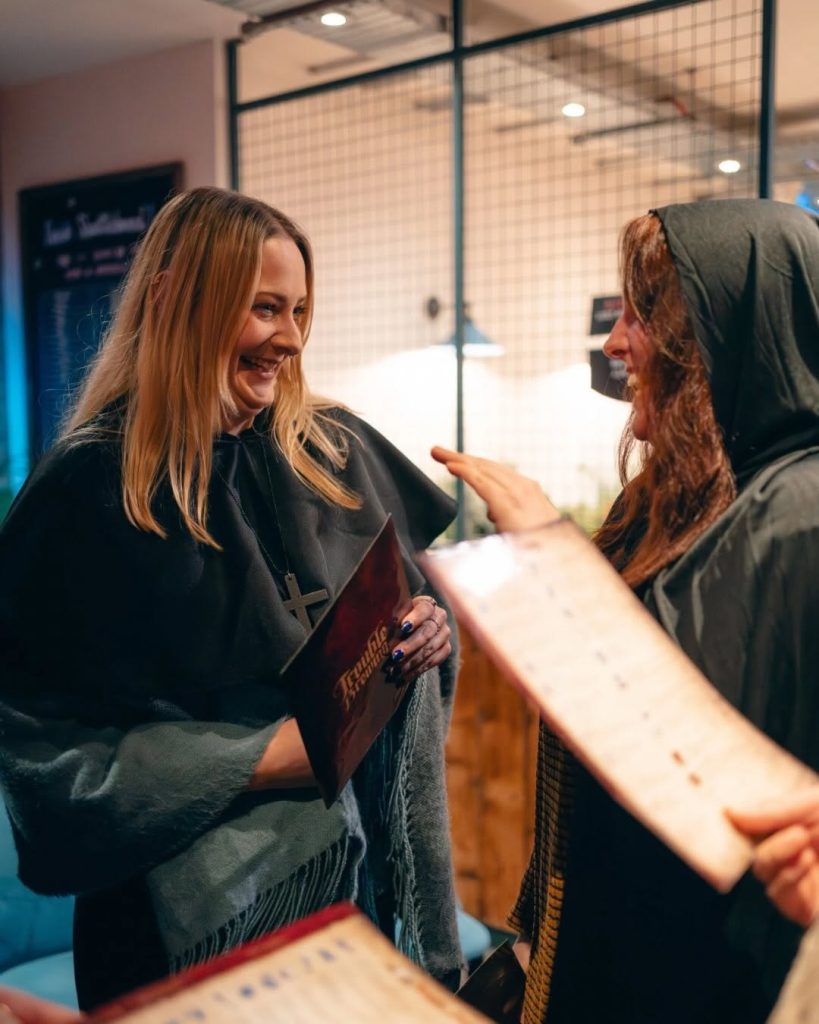
Wise, wise words from our storyteller, at Chance & Counters, Cardiff.
I’ve been to a couple sessions myself, with zero (zero) background knowledge or preparation, and cannot emphasise enough how much fun the game is, how lovely the community around it is, and how helpful they are when you have no clue what you’re supposed to do. It’s a great chance to have fun, do something a little outside of the ordinary, and just be around great, funny people.
If this sounds like something you’d like to try, make sure to keep an eye on our socials for news and book your ticket through our events page! Fight some evil, do some evil, have a cheeseburger, have a cocktail, have a great time!
Find online all events available at our Chance & Counters board game cafés in Leeds, Bristol, Cardiff and Birmingham.